
9.1.1Is the sum of an infinite geometric series infinite?
Infinite Geometric Series
Is
The three dots at the end of
CALCULATING THE SUM OF AN INFINITE GEOMETRIC SERIES
The series in problem 9-2 is geometric because it has a common ratio. The common ratio is the multiplier used to get the next term from the previous term. For each series below, determine if the sum is finite. If so, determine its sum.
Now reverse the process. With your team, write an infinite geometric series with each of the following sums.
sum diverges
(is not finite)
Devon needs to convert
ZENO'S PARADOX OF ACHILLES AND THE TORTOISE
The ancient Greeks were bothered by the same paradoxes of infinity that have disturbed the sleep of philosophers and mathematicians for centuries. For example, though they could calculate areas bounded by many curved figures, including parabolas, by using “infinitesimal” methods that crudely involve the idea of a limit, their taste for strictly correct reasoning would not allow them to consider curves such as polygons with an infinite number of sides. They found the following paradox, attributed to Zeno, very troubling.
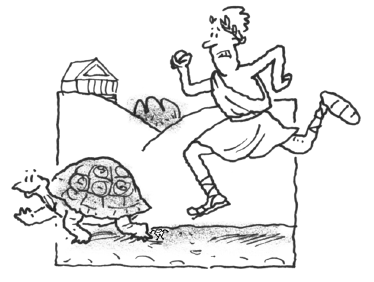
Suppose Achilles runs ten times as fast as a tortoise, but the tortoise has a When Achilles had finished running the first 1000 yards, the tortoise would still be |
With your team, act out the paradox. One person will play the role of Achilles, while another person will be the tortoise. Determine a starting line, give the tortoise a “
yard head start,” then go! Does Achilles ever overtake the tortoise? What is the flaw in Zeno’s logic? Discuss this briefly in your study team.
RESOLVING ZENO’S PARADOX
Zeno’s and other similar paradoxes were not resolved satisfactorily until the 18th century! One of the most convincing explanations involves computing the sum of the times needed for Achilles to advance to each of the key points. It turns out that this is the sum of a geometric series.
Consider the diagram below.
.png)
To make the situation more concrete, suppose Achilles runs at
yards per second, and the tortoise crawls at yard per second (quite fast for a tortoise!). Copy and complete the following table showing times and distances between the marked positions.
Distance for Achilles (yds) | |||
Distance for Tortoise (yds) | |||
Time (secs) |
Let
be the amount of time it will take Achilles to catch up to the tortoise’s previous position. Use the pattern in the table to write an infinite series for . Then sum the series. Explain your answer to the part (b) in the context of Zeno’s argument (from problem 9-6). Does this resolve the paradox? If so, what unjustified assumption did Zeno make about the sum of an infinite series?

Convert
Examine the integrals below. Consider the multiple tools available for integrating and use the best strategy for each part. Evaluate each integral and briefly describe your method. Homework Help ✎
Use the washer method to calculate the volume of the solid generated by revolving the region bounded by
Calculate the exact length of the curve
Multiple Choice: Assume that the acceleration due to gravity in the absence of friction is
m
m
m
m
m
Ying has a different method for summing an infinite series. Here are her steps: Homework Help ✎
1) Let
the sum. 2) Separate the first term from the rest of the series.
3) Factor the rest of the terms so that the remaining factor is
. 4) Substitute
for the other factor. 5) Solve for
.
Apply Ying’s method to the following problem. The first three steps are done for you. Copy them, then complete the solution.
Problem:
Start of Solution:
How far had Achilles run when he caught up with the tortoise? Homework Help ✎
Convert


